OUr Story
Red River Gorge United formed in 2019 as a community response to state-backed plans for a “well-planned modern Gatlinburg” for the RRG.
Tourism Generator Location Determination Process
Three years later, in 2016, the task force banded together again, commissioning another study from Hospitality Valuation Services (HVS) focusing on the Red River Gorge region as the location of the project.¹⁰ As AECOM studies stated, “current visitors to the region would be the easiest to market to.⁹” From a business perspective, then, it made sense to anchor the project in an already booming tourist location.
Yet, as a goal-oriented, publicly-funded, value-driven approach to “to address the rapid economic decline in Kentucky's eastern coalfields,” such a move made much less sense. Available Kentucky Chamber coal data⁶ from 1988-present shows Powell county, the county chosen as the locus of the project, accounted for zero coal jobs.⁷ The adjacent county, Menifee, likewise, records no coal employment. Wolfe did once account for thirty commuting jobs, as no active mine existed in the county. Lee county, the furthest from the Slade, the epicenter of the proposed tourism project, comes closest to what one might stretch to consider a coal area. Records show that Lee County had one active surface mine in 2019, with 104 employed at peak employment.⁶ Altogether, the four-county region accounts for 0.5% of coal jobs lost in Eastern Kentucky.
RRGU Forms
Two and a half months after receiving the million dollars grant monies, RRED released its vision to the public for the first time on October 17th, 2019, at Natural Bridge State Park.¹⁴ As David Adkisson later explained,
"At some point, you come to the public and say, ‘We’ve got this concept, and we now have a grant, and we’d like to pursue this with you. Versus coming in with all the answers and saying, ‘by the way, we’re ready to go, you all stand back, things are ready to go, and trucks are out there ready to do whatever…Clearly, here today, we are to ask for community engagement.¹”
The community bristled at the idea of Gatlinburg-like development.¹⁵ For many of them, such an idea was a no-go. Susan Ventura of Miguel’s Pizza went so far as to start a petition against the project, citing materials from the HVS study, recommending a themed village as part of the project, anticipated to attract an additional 1-2 million people annually.¹⁶ As of August 2021, the petition received over forty-three thousand signatures from locals and international tourists.¹⁶ As one Kentucky signer put it,
We don’t want [it] to be Gatlinburg. We want [it] to be the Red River Gorge. The people that love the Gorge don't go to shop outlet malls, stay in fancy resorts, or eat [sic] at olive garden. They go to experience the beauty, peace, and tranquility that this truly one-of-a-kind place provides. A few dollars in tax revenue is not worth selling out our people and Kentucky's soul.¹⁶”
In other words, to many, the very draw of the Gorge and the Eastern Kentucky region is its’ uncommercialized character. This observation is in keeping AECOM study’s findings, which report that “the majority of visitors to Eastern Kentucky come to the region because it is peaceful/relaxing.⁹” Large-scale commercial development contradicts the present enticing allure of the region.
Soon after the Oct 17th, 2019 announcement meeting, Red River Gorge United a community response to top-down development plans. In opposition to Gatlinburg-style development, RRGU mission was to balance the local community, visitor experience, ecology, natural beauty, and heritage of the Red River Gorge area while maintaining sustainable economic growth.
Here’s how those plans BEGAN
In the ten-year span of 2002-2012, Eastern Kentucky lost 3243 jobs⁶ in the coal industry.⁷ Down from an all-time high of 23,067 jobs in 1990, only 9277 jobs⁶ remained.⁷ Even before the advent of the mass coal industry fallout, 38 out of 54 eastern Kentucky counties were listed as distressed.⁸ In light of these events, officials became very concerned about the prospects of the region. In 2013, the Kentucky Chamber of Commerce appointed a special task force to confront the issue.³ What possible economic aid could be relevant to address such a huge, region-wide disparity? The task force decided to look into the viability of large-scale tourism to meet the demand, commissioning a study² from the international engineering firm AECOM.⁹ As Charles Booth, then chairman of the Chamber, put it, “Tell us if there could be a well-planned Gatlinburg in Eastern Kentucky².”

The Project Continues
Nevertheless, HVS studies returned, stating that among other attractions, a “well-planned modern themed village would attract 1-2 million additional people to the area.¹⁰” From that point on, the project that began as a “well-planned Gatlinburg” gained traction. The task force banded together to create the non-profit organization Red River Gorge Economic Development (RRED), creating a concept paper in order to apply for grant monies.¹³ On July 1st, 2019, the RRED secured a million dollars in funding for the project.¹ It took a year and a half to apply for the desired grants. On July 1st, 2019, RRED received $500,000 from the Appalachian Regional Commission (ARC), with a matching grant of $500,000 sourced from the Coal Severance Tax of the State Of Kentucky.¹⁴ With these funds secured, members of RRED considered the project real. It was no longer just a “pipe dream,” according to David Adkisson, former CEO of the Kentucky Chamber, project manager of RRED at the time.¹ The day these funds became available, on July 1st, RRED broadcasted a national “request for proposals³” for companies to develop a master plan for the project.¹ Within a month, they had twenty-six firms indicate that they were interested in developing a plan. RRED narrowed its parameters for application and, once again, sent the request out nationally. Shortly after, they received thirteen responses, largely from international firms.
RRGU Early Days
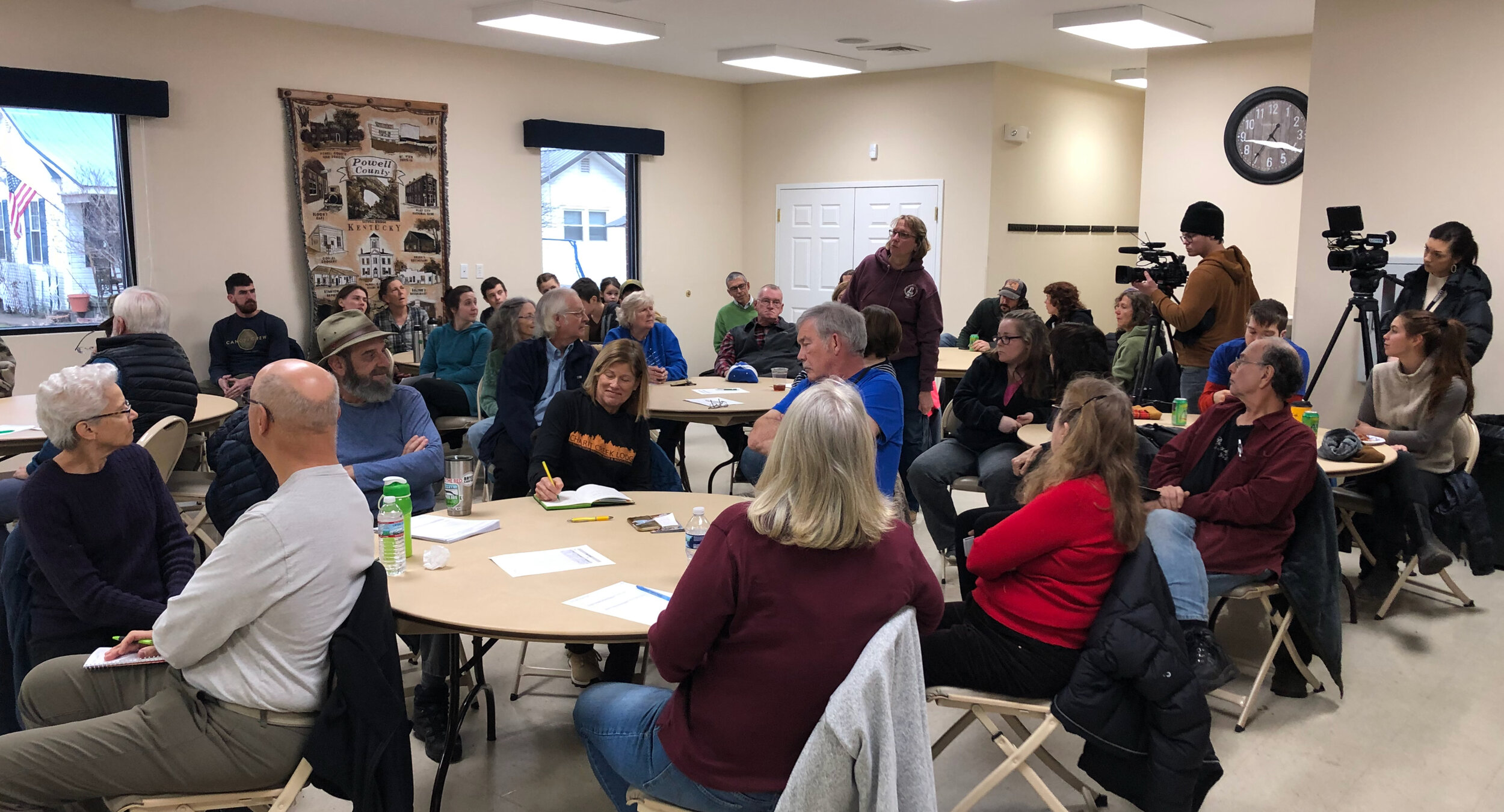
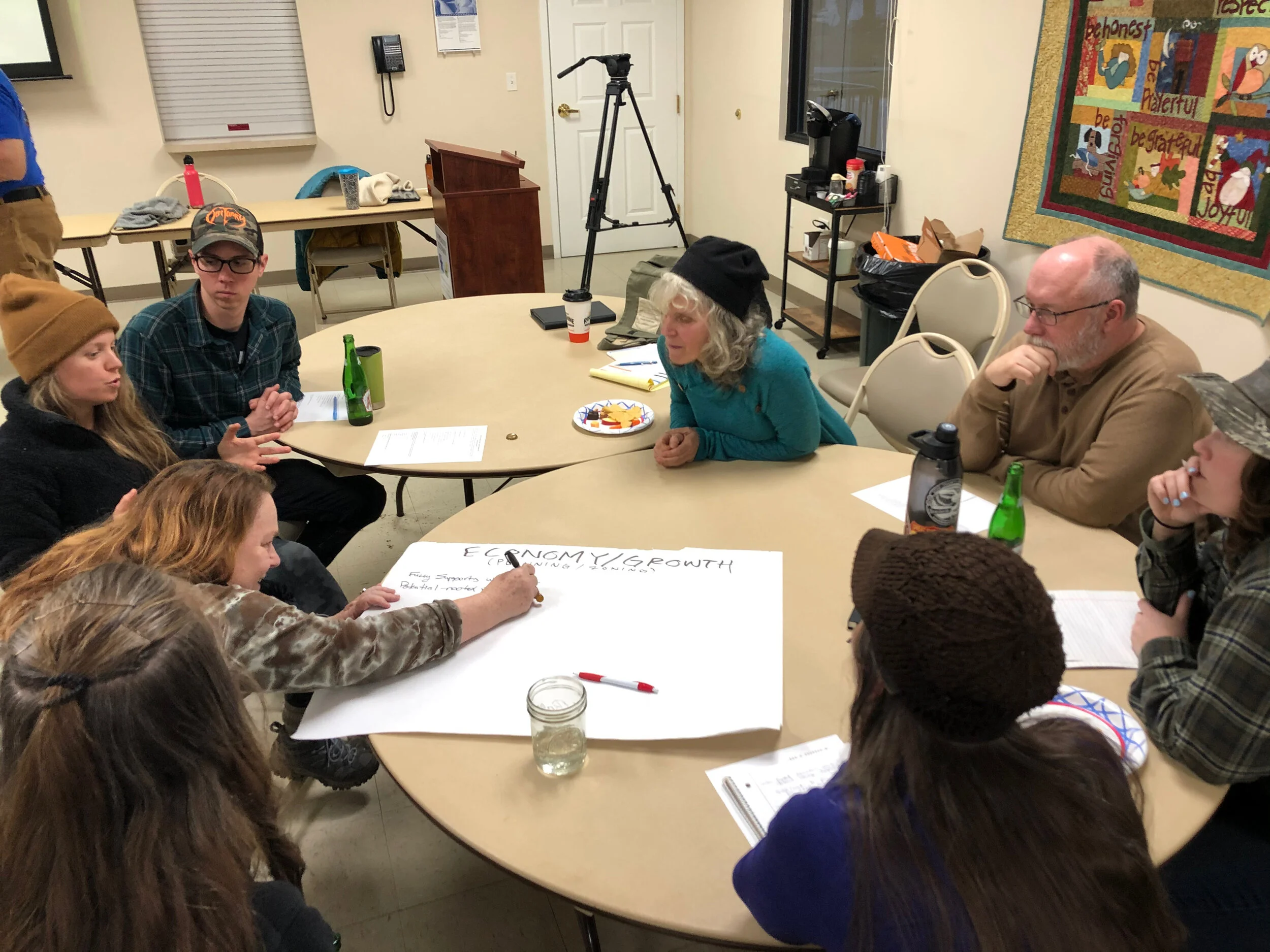
Discerning how best to respond to the “Well planned modern Gatlinburg” threats proved challenging. At that point, the project had six years of development, state support, hundreds of pages of studies, and a million dollars of seed funding. Red River Gorge United hosted several community meetings, working to understand the best course of action. Another important step was spending time researching the studies and proposals published, and the rationale behind them.
Need For a Positive Solution
The “Well-planned modern Gatlinburg” began as a proposed solution to the coal-collapse of eKY. If RRGU opposed a Gatlinburg in the RRG as the solution to the coal economy, what would be a better solution to this issue?
Tourism can be an incredible asset
Tourism is a powerful economic tool. Powerful enough to either uplift or destroy a region. Perhaps in most cases, to uplift first and obliterate shortly after. The task at hand is to determine how to harness this force for the greatest sustaining, generational economic, and societal gain. The key is to guide efforts in such a way so as to make tourism serve communities and to establish safety measures to prevent tourism from consuming communities and place.
Mass-scale tourism, whether in the Red River Gorge or elsewhere, may serve to harm communities more than help in the long-term arc of events. Instead of focusing tourism traffic on a tiny geographic area, it appears that the goal for a viable future for the Eastern Kentucky Region must aim at bringing the appropriate amount of visitors to the towns across the whole region. RRGU coined the term "dispersed tourism” to describe a better alternative.